

Long before powerful empires emerged across West Africa, a sophisticated society was already flourishing in the hills and valleys of what is now central Nigeria.
The Nok culture, which flourished from roughly 1000 BCE to 300 CE, is regarded as one of Africa’s earliest complex societies and is renowned for its distinctive terracotta sculptures, among the earliest known examples of figurative art in sub-Saharan Africa.
Named after the village of Nok in present-day Kaduna State, where the first terracotta sculptures were discovered in 1943 during tin mining, the culture occupied a vast area encompassing parts of modern Kaduna, Plateau and Nasarawa states and the Federal Capital Territory.
For more than 1,300 years, Nok communities developed settled agricultural societies, mastered ironworking and produced an extraordinary body of artistic work that continues to intrigue archaeologists.
The Nok are among the earliest known ironworking communities in sub-Saharan Africa. Archaeological evidence suggests that iron production was already established in the Nok cultural area by the first millennium BCE. Iron tools would have helped communities clear vegetation, cultivate crops and expand agricultural production, while iron weapons could have served hunting and defence.
Archaeological excavations have revealed evidence of settlements, pottery production and iron-smelting furnaces, pointing to communities with specialised skills and organised economic activity. Rather than simply adapting to their environment, the Nok developed technologies and artistic practices that marked them out among the early societies of West Africa.
Yet it is the Nok’s terracotta art that has given the culture its enduring place in African archaeology.
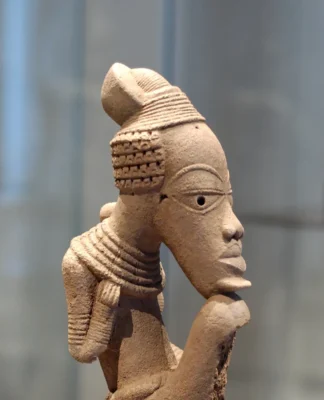
From roughly the first millennium BCE, Nok artists produced remarkable terracotta heads and human figures characterised by distinctive features, including elongated heads, carefully rendered hairstyles, prominent eyes, jewellery and expressive facial forms.
Some sculptures portray individuals wearing elaborate clothing, beads, armlets and headgear. Others depict animals and aspects of human activity. The precise purpose of the figures remains uncertain, although archaeologists have proposed ritual, funerary, commemorative and ancestral functions.
The sophistication and stylistic consistency of Nok terracottas provide important evidence of a highly developed artistic tradition. However, claims that the Nok directly influenced the later artistic traditions of Ife and Benin remain the subject of scholarly debate, largely because of the substantial chronological and geographical gaps involved.
The Nok were not an empire in the conventional sense. Archaeological evidence points instead to dispersed communities that may have maintained social, cultural and economic connections. Their economy was rooted in agriculture, while specialist activities such as pottery, ironworking and terracotta production suggest a degree of occupational specialisation.
Their communities existed within a wider landscape of interaction across what is now central Nigeria, where people, technologies and materials moved through networks that connected settlements and river valleys.
By about 300 CE, the archaeological record associated with the Nok culture changed significantly, although the reasons for the transformation remain uncertain. Researchers have proposed several possible explanations, including environmental change, shifts in settlement patterns, pressure on resources and social transformation. There is no single explanation universally accepted by scholars.
Nor is it possible to draw a simple, direct line between the Nok and any single modern ethnic group. While the culture formed part of the deep archaeological history of central Nigeria, the identities of its people and their precise relationship with later populations remain subjects of ongoing research.
The significance of Nok civilisation, however, is beyond dispute. Its archaeological record demonstrates that complex communities, sophisticated ironworking and remarkable figurative art were developing in West Africa more than 2,000 years ago.
Nok terracottas have attracted international attention, while questions surrounding the illicit excavation and trafficking of archaeological artefacts have also placed the culture at the centre of debates about cultural heritage, museum collections and the restitution of African antiquities.
Today, archaeologists continue to investigate Nok sites using excavation, scientific dating, landscape studies and other modern techniques. Each discovery offers another fragment of evidence about how these early communities lived, worked, worshipped and expressed themselves.
For Nigeria, the Nok legacy represents far more than an archaeological curiosity. It is a powerful reminder of the technological ingenuity, artistic achievement and social complexity that existed in the region long before the emergence of the better-documented kingdoms and states of West Africa.
More than two millennia after Nok artists shaped human faces from clay, their work continues to challenge assumptions about Africa’s ancient past and to deepen the understanding of Nigeria’s place in the history of early civilisation.