
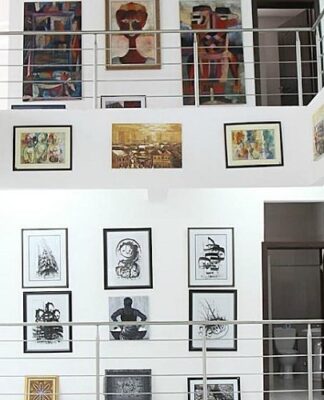

Have you imagined walking into a five-story gallery filled with colorful Adire fabrics, intricate wood carvings, bronze sculptures, and contemporary paintings by Nigerian artists. The air smells faintly of dye and wood, and every wall tells a story.
That is the Nike Centre for Art and Culture
Founded by renowned Nigerian artist and cultural icon Chief Nike Davies-Okundaye, the Centre has become one of West Africa’s largest art galleries and a living museum of Nigerian creativity. With branches in Lagos, Abuja, and Osogbo, the flagship gallery in Lagos stands five stories tall and houses thousands of artworks.
Do you know that the ground floor opens into a riot of color — shelves and racks of hand-dyed Adire, the iconic indigo fabric of the Yoruba people. Upstairs, visitors are met with towering wooden carvings of gods, kings and ancestral figures, alongside beadwork, leather crafts, and pottery.
The upper floors shift to contemporary Nigerian art: bold paintings, mixed media, and textiles by emerging and established artists from across the country. It is where tradition meets the now.
What makes the Centre unique is that it is not just a gallery. It is a working school. Hundreds of young Nigerians, many of them women, are trained free of charge in weaving, dyeing, painting, and sculpture. The goal: preserve skills, create jobs, and export Nigerian culture to the world.
For tourists, the Nike Centre is a must-visit in Lagos. For artists, it is a launchpad. For Nigeria, it is soft power in action — proof that culture can drive tourism, employment and national identity.
Chief Nike Davies-Okundaye often says the Centre exists “to make sure our children do not forget where they come from.” Walking through the five floors, you understand why. Each Adire pattern is history. Each carving is a proverb. Each painting is a conversation.
In an era of globalisation, the Nike Centre stands as a reminder that Nigerian art is not in museums abroad alone. It is here, alive, being made, sold, and taught.