
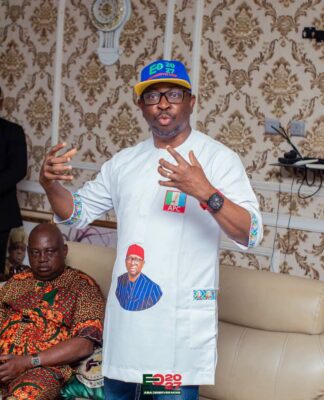

There is a way you know when politics is about to change in Abia. It is not in the noise on social media. It is not in the big billboards in Umuahia or the sponsored jingles on radio. It is in the small halls in places like Obingwa, Osisioma and Ugwunagbo, where ordinary people gather to listen to a man and decide for themselves whether he is serious.
That was what happened on Thursday, 12th November 2026, when Chief Eric Chinemeucheya Opah, the governorship candidate of the All Progressives Congress, took his town hall meetings and stakeholders engagement to those three local governments ahead of the formal flag-off of his campaign.
He did not come to shout. He came to listen. And in Abia today, listening is itself a political statement.
For too long, governance in this state has felt like a broadcast from one man to the rest of us. Decisions are taken, figures are announced, projects are claimed, and the people are expected to clap. Opah went in the opposite direction. He sat with party leaders, ward executives and faithful, and asked them to speak about what they are going through.
What they told him is what many Abians have been whispering in markets, in churches, in motor parks and in their homes. People are hurting. Workers in Abia, the men and women who keep the schools, hospitals and ministries running, are the worst paid in the South-East and are treated without dignity. Small business owners, the traders and artisans who feed their families from daily hustle, are being squeezed by excessive taxation and multiple levies. There is a quiet disappointment hanging over the state, a feeling among many who voted in 2023 that they were promised something different from what they are now living through.
Opah did not pretend that government does not need money. He acknowledged that tax is necessary. What he questioned was the manner of it, the draconian regime that punishes enterprise instead of nurturing it. What he questioned was the idea that a government must make workers miserable to build roads, or impoverish traders to provide infrastructure. In his words, government can work and still take care of the welfare of the people.
That is why his criticism of the present administration cut deeper than mere opposition talk. He asked the question that follows every Abian each time a new budget performance report is read out. If over N1.8 trillion has already come into the state in total revenue, why does it not show in the lives of the people? Why are hundreds of billions claimed for projects that cannot be found on the ground? Why are contract costs inflated, why is there so much impunity, why is there so little accountability? His answer was blunt and moral rather than technical. Greed begets corruption. And when public office becomes an opportunity for a few individuals to treat government funds as private property, the state loses its soul.
He described the present administration as a government centred around one individual, and argued that governance should be about institutions, collective responsibility and the welfare of the people, rather than the preferences of one man. For a people who have watched power become personalised, that argument lands with a particular force.
Opah was equally clear about his own politics. There is no alliance with any other governorship candidate. He is in the race to win. He asked APC members in the three local governments to remain united, to mobilise at the grassroots and to carry the message to every community, because victory, if it comes, will not come from Abuja alone. It will come from hard work and genuine engagement.
The most telling moment of the day was not in the speeches. It was in the reception of defectors from other political parties into the APC, welcomed with the symbolic broom. Defection is the oldest thermometer in Nigerian politics. People do not leave a ruling party for an opposition party unless they sense a shift in the wind. That people are crossing over even before the formal flag-off suggests that something is moving in Ngwa land.
The presence of leaders like Chief Charles Ogbonnaya, known as Evulugo, Rt. Hon. Martins Azubuike, Elder John Nwangborogwu, Hon. Aaron Uzodike, the member representing Aba North State Constituency, Elder Godwin Nna, Chief Udo Alozie, the APC candidate for Obingwa, Ugwunagbo and Osisioma Federal Constituency, and other candidates, gave the meetings weight. It showed a party that is beginning to speak with one voice in a zone that has often been divided by personal ambition.
Yet honesty demands that we say what town hall meetings cannot do. They cannot vote. They cannot protect polling units. They cannot by themselves defeat an incumbent who still commands a large following and a formidable media machine. What happened in Obingwa, Osisioma and Ugwunagbo will mean nothing if Opah and his running mate, Dr. Godswill Agu Egbe, fail to turn listening into organisation, and organisation into votes, ward by ward and polling unit by polling unit.
What it does mean, however, is that the campaign has moved from announcement to encounter. From a name on a poster to a man in a hall, answering questions and taking notes. From social media to the people.
And in Abia, when the people begin to speak for themselves, history has a way of listening.
Emmanuel Achilihu writes from Amade.