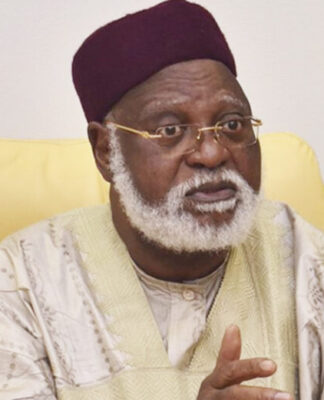

The story of Nigeria’s return to democratic governance in 1999 is incomplete without the remarkable contribution of General Abdulsalami Abubakar, the military leader who oversaw one of the country’s most pivotal political transitions.
When the then Head of State, General Sani Abacha, passed away in 1998, Nigeria faced a defining moment. With uncertainty in the air and the country in need of steady leadership, Abdulsalami Abubakar emerged as the stabilizing figure who steered the nation toward democracy.
Renowned both within Nigeria and in international political circles, General Abdulsalami Abubakar is best remembered for spearheading the transition from military rule to civilian government. But his role went beyond that. He successfully midwifed the return to democracy by supervising the drafting of a new constitution and eventually handing over power to the elected President, Chief Olusegun Obasanjo, in May 1999.
Today, General Abubakar is widely regarded as a respected elder statesman. His commitment to peace and nation building continues through his role as Chairman of the National Peace Committee, a body dedicated to promoting peaceful elections and resolving conflicts across the country.
*The Man General Abdulsalami Abubakar*
Born on June 13, 1942, in Minna, Niger State, Abdulsalami Abubakar began his education at Minna Native Authority Primary School before proceeding to Government College Bida for his secondary studies.
He joined the Nigerian Air Force in 1963 before transferring to the Nigerian Army, where he built an illustrious military career. Notably, he led Nigeria’s United Nations peacekeeping contingent in Lebanon in 1981 and later served as Chief of Defence Staff from 1997 to 1998.
*Head of State 1998 to 1999*
General Abubakar assumed office following the sudden death of General Sani Abacha. His administration is celebrated for its clear sense of purpose to return Nigeria to democratic rule without delay.
He implemented a new constitution, revived political structures, and organized the series of elections that eventually ushered in the Fourth Republic. His approach earned him widespread respect, as he acted with speed, fairness, and an unusual level of humility for a military ruler.
One of the key promises he made upon assuming office was to conduct elections within one year, a promise he kept.
To demonstrate commitment, he established the Independent National Electoral Commission INEC which was tasked with organizing the transition elections. Under his leadership, INEC successfully conducted elections into local governments, state houses of assembly, governorship positions, and National Assembly seats.
The process culminated in the presidential election of February 27, 1999.
Although some international observers criticised the elections as not entirely free and fair, General Abdulsalami Abubakar remains highly regarded for his integrity and dedication in ensuring the transition occurred on schedule. He kept to his word and handed over power, something Nigerians had long hoped for.
General Abdulsalami Abubakar The Brain Behind Nigeria’s 1999 Democratic Transition