
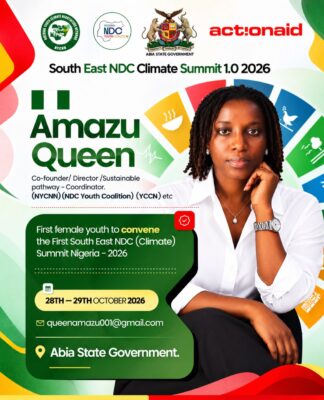

Summit to connect Nigeria’s NDC 3.0 targets with state priorities, youth participation and green economy opportunities across Abia, Anambra, Ebonyi, Enugu and Imo
By Our Special Correspondent
As Nigeria moves from climate commitments to implementation under its updated Nationally Determined Contribution (NDC 3.0), a critical question is gaining urgency: How do national climate policies translate into the realities, priorities and voices of young people at state and community levels?
In the South-East, that question is being answered with practical action through the work of Amb. Queen Amazu, South-East Regional Coordinator of the Nigerian Youth Climate Negotiators Network (NYCNN), and her team.
Amazu’s work cuts across national, regional and state climate governance spaces, with a clear focus on ensuring that young people are not merely beneficiaries of climate policies, but active participants who understand, shape and contribute to their implementation.
Nigeria formally submitted its NDC 3.0 to the UNFCCC in September 2025, outlining updated commitments under the Paris Agreement. However, the NDC Partnership has noted that young people remain underrepresented in formal climate decision-making, stressing that meaningful youth engagement is critical to successful implementation.
The Missing Link: From National Policy to Local Realities
Evidence points to a knowledge and participation gap.
A study involving young people in South-Eastern Nigeria found that while awareness of climate change was high, knowledge of its causes and impacts was comparatively weaker.
Another study on sustainability and climate-policy participation in Nigeria found that awareness of climate-policy implementation at the local level was limited, potentially restricting meaningful stakeholder engagement.
Importantly, this is not due to lack of research at state level. A recent nationwide assessment describes itself as the first comprehensive evaluation of climate awareness, policy development and action across all 36 states, yet youth-specific, state-level evidence remains largely underdeveloped.
It is within this gap that Amazu’s regional work is strategically positioned.
Bringing the South-East Voice into the NDC 3.0 Conversation
In 2026, Amazu participated in key national climate processes in Abuja, including the National Young People’s Convening on NDC 3.0 and Climate Action, where youths from across the six geopolitical zones deliberated on priority areas such as energy transition, transport, agriculture, nature-based solutions, resilient livelihoods and climate governance.
She also participated in the Nigeria Youth Climate Summit 2026, held in Abuja from June 2 to 3 and convened by the National Council on Climate Change in collaboration with UNICEF, with focus on youth leadership and NDC 3.0 implementation.
For Amazu, however, participation at the national level is only one part of the work.
The bigger question, she notes, is what happens after Abuja.
How do national climate conversations reach students in Abia? How does a young entrepreneur understand green economy opportunities? How does a farmer connect climate policy with agriculture and livelihoods? And how does a young person know where their voice fits into state climate planning?
These questions have continued to shape her approach to climate advocacy.
From Regional Leadership to State-Level Action
As South-East Regional Coordinator of NYCNN, Amazu works across Abia, Anambra, Ebonyi, Enugu and Imo States, creating platforms for young people to engage with climate governance and policy.
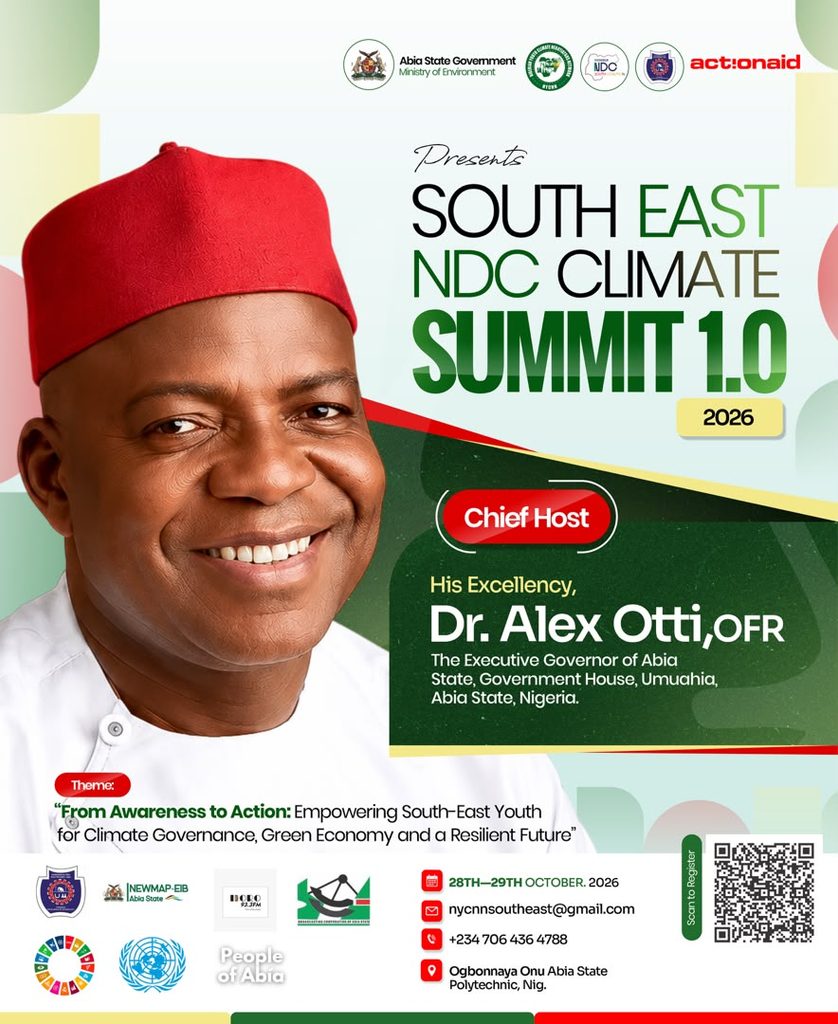
The South-East NDC Climate Summit 1.0, scheduled for October 28–29, 2026, at the Ogbonnaya Onu Polytechnic, Abia State, represents a major extension of that regional work.
Themed “From Awareness to Action: Empowering South-East Youth for Climate Governance, Green Economy and a Resilient Future,” the summit is not designed to be just another climate conference.
Its objective is to create a structured space where young people can examine the region’s climate priorities, interrogate sector-specific challenges and develop youth-driven perspectives capable of feeding into wider policy conversations.
The summit is expected to bring together young people, government institutions, development partners, civil society, academia and the private sector for discussions spanning climate governance, green economy, sustainable development and youth participation.
Working With Government, Not Around Government
A central pillar of Amazu’s approach is constructive engagement with government institutions.
In Abia State, the Department of Climate Change was established in 2023 under the Ministry of Environment to coordinate the state’s climate action agenda, including mitigation, adaptation, vulnerability assessment, greenhouse-gas inventory, and climate education and awareness.

The state’s climate roadmap also includes clean cooking, green infrastructure, climate financing and community-driven resilience initiatives.
Amazu and NYCNN have engaged with the Abia State Government around these emerging priorities, including the Abia State Clean Cooking Plan, where youth perspectives were integrated into conversations on energy access, public health, livelihoods, environmental protection and climate mitigation. The state’s Clean Cooking Plan was launched in January 2026.
The model is practical: national policy informs state action, state realities shape youth engagement, and youth perspectives feed back into national climate conversations.
Capturing the Voices Behind the Statistics
For Amazu, a major outcome is ensuring that young people across Abia and the wider South-East are not spoken for without being heard.
Her approach is to take climate education and policy conversations beyond government offices and conference halls into schools, tertiary institutions, communities, youth organisations and professional spaces.
The goal is to understand what young people actually know about climate change, which sectors affect their livelihoods, what opportunities they see in the green economy and what barriers prevent them from participating in climate decision-making.
Such an approach, she believes, will generate more locally grounded evidence while strengthening the link between youth priorities and climate policy. It also aligns with a broader principle recognised by international climate institutions: youth participation in NDC processes must extend beyond attendance to meaningful involvement in development, planning and implementation.
A Regional Platform with a National Purpose
The South-East NDC Climate Summit therefore represents more than a two-day event.
It is part of a deliberate effort to build a South-East youth climate governance pipeline — from awareness to education, consultation, policy engagement and ultimately, implementation.
For Abia, it offers an opportunity to connect the state’s evolving climate governance architecture with young people who will live with the long-term consequences of today’s policy choices.
For the South-East, it creates a collective platform to articulate regional priorities.
And for Amazu, it marks the progression of a journey that has moved from participating in national climate conversations to building structures that bring those conversations home and translate them into local action.
The message at the heart of her work is simple but powerful: NDC 3.0 cannot remain a national document understood only by policymakers. Its implementation must be understood, discussed and experienced at the state and community levels.
That is the space the South-East NDC Climate Summit seeks to occupy — bringing the conversation from Abuja to Abia, from policy to people, and from awareness to action.