
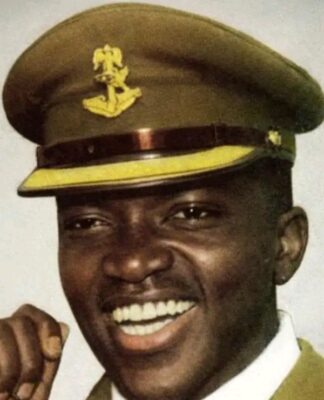

Major Chukwuma Kaduna Nzeogwu was one of the most influential and controversial figures in Nigeria’s political and military history.
His leadership of the country’s first military coup on January 15, 1966, marked a turning point that profoundly altered Nigeria’s political trajectory and ushered in an era of military rule.
Born on February 26, 1937, in Kaduna to Igbo parents from Okpanam, near Asaba in present day Delta State, Nzeogwu became widely known by the nickname “Kaduna” because he was raised and educated in the northern city.
He received his military training at the Royal Military Academy Sandhurst in the United Kingdom and earned a reputation among his peers for his intelligence, discipline, courage, and professionalism.
In the early hours of January 15, 1966, Nzeogwu led a group of young military officers in an attempted coup against the civilian government of the First Republic. The operation resulted in the deaths of Prime Minister Sir Abubakar Tafawa Balewa, the Premier of the Northern Region, Sir Ahmadu Bello, the Premier of the Western Region, Chief Samuel Akintola, and several senior military officers and political figures.
Nzeogwu seized control of Kaduna and delivered a broadcast over Radio Nigeria, stating that the objective of the intervention was to end corruption, political instability, and ethnic divisions while establishing a more accountable government.
Although the coup succeeded in parts of northern Nigeria, it failed to secure nationwide control. Similar operations in Lagos and other strategic locations were suppressed. In the aftermath, Major General Johnson Aguiyi Ironsi, who was not identified as one of the coup planners, assumed power as Nigeria’s first military Head of State.
Because many of those killed were prominent northern and western political leaders while several leading Igbo politicians survived, the coup was widely perceived in many quarters as having an ethnic dimension, despite Nzeogwu’s repeated insistence that it was motivated by national rather than ethnic considerations.
The events deepened political distrust and contributed to the July 1966 counter coup, setting Nigeria on a path that eventually culminated in the Nigerian Civil War.
Following the failed coup, Nzeogwu was arrested and detained. He regained his freedom after the July 1966 counter coup and the subsequent breakdown of central authority. When the Nigerian Civil War began in 1967, he joined the Biafran Army, where he served as a Lieutenant Colonel. He was killed in action near Nsukka on July 29, 1967, at the age of 30, bringing to an end a brief but highly consequential military career.
More than half a century after his death, Major Chukwuma Kaduna Nzeogwu remains one of the most debated personalities in Nigeria’s history. To some, he was an idealistic officer who sought to reform a political system he believed had become deeply corrupt.
To others, his actions accelerated a chain of events that led to prolonged military rule, political instability, and civil war. Whatever the perspective, the January 15, 1966 coup remains one of the defining moments in Nigeria’s post independence history, reshaping the nation’s political landscape for decades to come.