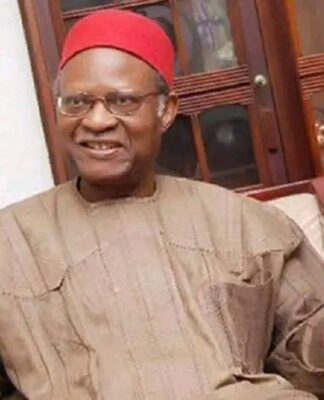

There is no gainsaying the fact that reaching the pinnacle of life requires consistency, uprightness and unwavering commitment to service.
Nigeria has, without doubt, produced distinguished minds who have demonstrated dedication and rendered selfless service in positions of trust. One of such individual, whose name is firmly etched in the annals of history, is Chief Emeka Anyaoku.
Born on 18 January 1933 in Obosi, Anambra State, Emeka Anyaoku rose through the ranks of international diplomacy with exceptional distinction. He served as Deputy Secretary General of the United Nations and later made history as the third Commonwealth Secretary General, a position he held from 1990 to 2000.
Notably, Anyaoku was the first African to occupy the office of Commonwealth Secretary General, following an extensive career marked by high level negotiations and initiatives within the Commonwealth. His diplomatic journey also included service at Nigeria’s Permanent Mission to the United Nations in New York from 1963 to 1966.
Although he never served as United Nations Secretary General, his international influence remained profound. Between 2004 and 2005, he chaired the United Nations Secretary General’s Panel on International Support to African Development, linked to the New Partnership for Africa’s Development.
During Anyaoku’s tenure as Commonwealth Secretary General, the United Nations was led by Javier Pérez de Cuéllar, Boutros Boutros Ghali and Kofi Annan, a period that underscored his close engagement with global leadership.
On the home front, Anyaoku briefly served as Nigeria’s Minister of Foreign Affairs from October to December 1983. He resigned following a military coup, a decision widely regarded as a demonstration of his principled opposition to military rule.
A consistent advocate of democracy, Anyaoku used his international platform during the military regimes of Generals Ibrahim Babangida and Sani Abacha to press for the restoration of democratic governance in Nigeria.
In 1995, the Commonwealth suspended Nigeria following the execution of Ken Saro Wiwa, a move that exerted significant pressure and is often linked to the country’s eventual return to civilian rule in 1999.
Worthy of mention is his involvement in organising peace talks between Nigerian and Biafran representatives during the Nigerian Civil War, where he applied diplomacy in pursuit of a peaceful resolution to the conflict.
In recent years, Anyaoku has remained a prominent voice in national discourse, advocating fundamental constitutional restructuring. He has repeatedly argued that the 1999 Constitution poses a major challenge to Nigeria’s stability and development.
He currently leads a group of elder statesmen known as The Patriots, campaigning for a new people’s constitution that reflects Nigeria’s plural character and embraces true federalism.
Through decades of service, Emeka Anyaoku has earned recognition as a respected elder statesman. His enduring message remains clear: Nigeria’s survival and prosperity depend on justice, inclusive governance and a structure that fairly manages its rich diversity.
Emeka Anyaoku: A Life of Principle Diplomacy and Service to Nigeria and the World